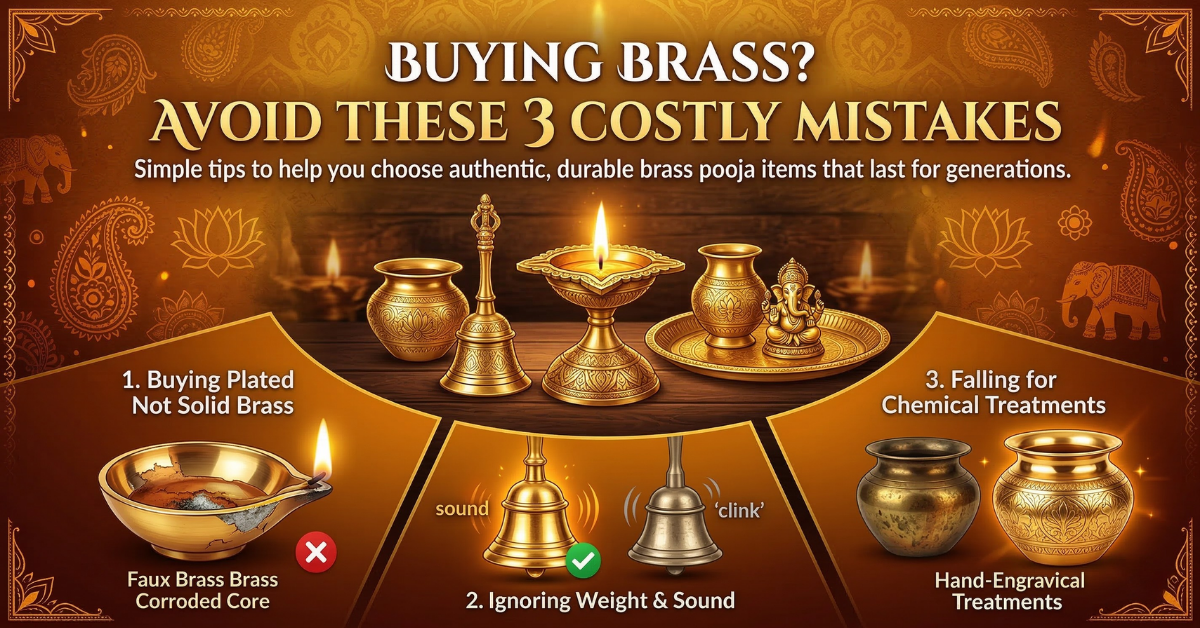
Buying pooja items should feel like a peaceful experience, right?
After all, these are objects you bring into your home for prayer, rituals, and blessings. Whether it’s a diya, bell, pooja thali, or temple lamp, brass items carry a strong spiritual and cultural value in many Indian homes.
But here’s something most people don’t realize.
A lot of buyers unknowingly make simple mistakes while purchasing brass pooja items. And those mistakes can lead to disappointment later — the item loses shine quickly, turns out not to be pure brass, or simply doesn’t last long.
Have you ever bought a brass item that looked great in the store but felt different after a few months?
You’re not alone.
Let’s talk about three common mistakes people make and how you can avoid them the next time you shop for brass pooja items.
This is probably the most common mistake.
Many items in the market look like brass, but they’re actually brass-plated or made from cheaper alloys. At first glance, they shine beautifully and seem identical to real brass.
But after some time, the truth shows up.
You might notice:
The color fading
The surface peeling
The item becoming dull quickly
That’s because the outer brass layer is extremely thin.
Real brass, on the other hand, has a natural golden tone that deepens with time instead of peeling.
Before buying, ask the seller:
Is this solid brass or brass-coated?
What is the weight of the item?
Solid brass items usually feel heavier and more solid in your hand.
If the price seems unusually cheap, that’s often a clue too.
Have you ever picked up two similar-looking brass lamps and noticed one feels lighter?
That difference matters more than you might think.
Many low-quality brass items are made with very thin metal, which means they can bend, crack, or wear out faster.
For pooja items that you’ll use regularly — especially diyas or lamps — durability is important.
Imagine lighting a diya every day and worrying about the metal weakening over time. Not ideal, right?
When buying brass items:
Hold the item and feel its weight
Check the thickness of the metal
Look for solid construction
A good brass diya or bell should feel sturdy and balanced.
Sometimes spending a little more upfront saves you from replacing the item later.
Let’s be honest for a moment.
Brass is beautiful, but it does require care.
Many buyers fall in love with the golden shine of a new brass item, bring it home, and then get surprised when the color starts changing over time.
But here’s the thing.
Brass naturally reacts with air and moisture, which causes tarnishing. That doesn’t mean the item is bad quality — it’s simply the nature of the metal.
Still, if you’re not prepared to maintain it, the item may lose its original shine.
Maintaining brass isn’t difficult.
Simple home methods work well, such as cleaning with:
Lemon and salt
Tamarind paste
Mild brass cleaning powder
Even occasional polishing can bring back that beautiful golden glow.
Think of it as caring for something meaningful rather than a chore.
Here’s something worth remembering.
Pooja items are often used for many years, sometimes even passed down through generations.
So when you buy brass items, you’re not just buying a decorative object. You’re bringing home something that might become part of your family traditions.
That’s why quality matters more than impulse buying.
Next time you’re shopping, take a few extra minutes to check the details.
Your future self (and maybe even your children) might thank you for it.
1. How can I tell if a brass pooja item is real?
Real brass items are usually heavier, have a warm golden tone, and don’t peel or chip like brass-plated items. You can also ask the seller for confirmation that it is solid brass.
2. Why do brass pooja items turn dark over time?
Brass reacts with air and moisture, which causes oxidation and tarnish. This is natural and can be cleaned easily with household methods.
3. Are brass pooja items better than steel ones?
Brass items are traditionally preferred for pooja because they are believed to carry spiritual and cultural significance. Steel is more convenient but less traditional for rituals.
4. How often should brass pooja items be cleaned?
It depends on usage, but cleaning them once every few weeks usually keeps them looking bright and polished.
5. Why are brass items used in temples and homes?
Brass is durable, beautiful, and traditionally believed to hold positive spiritual energy, which is why it is commonly used in both temples and household pooja rooms.
Since 1976. Pure Brass Pooja Articles & Kitchenware. Crafted with purity. Built to last. Trusted by generations of Indian homes.
Shri Dhanlaxmi Metal Industries
Baswan Galli, Cts No 4142/a/2, Hosur, Near Patson Agency, Belagavi, Karnataka – 590 003
Mob: +91 8296221234
Mob: +91 831 2488376
Email: sales@dmimart.in

No products in the basket.
No products in the basket.