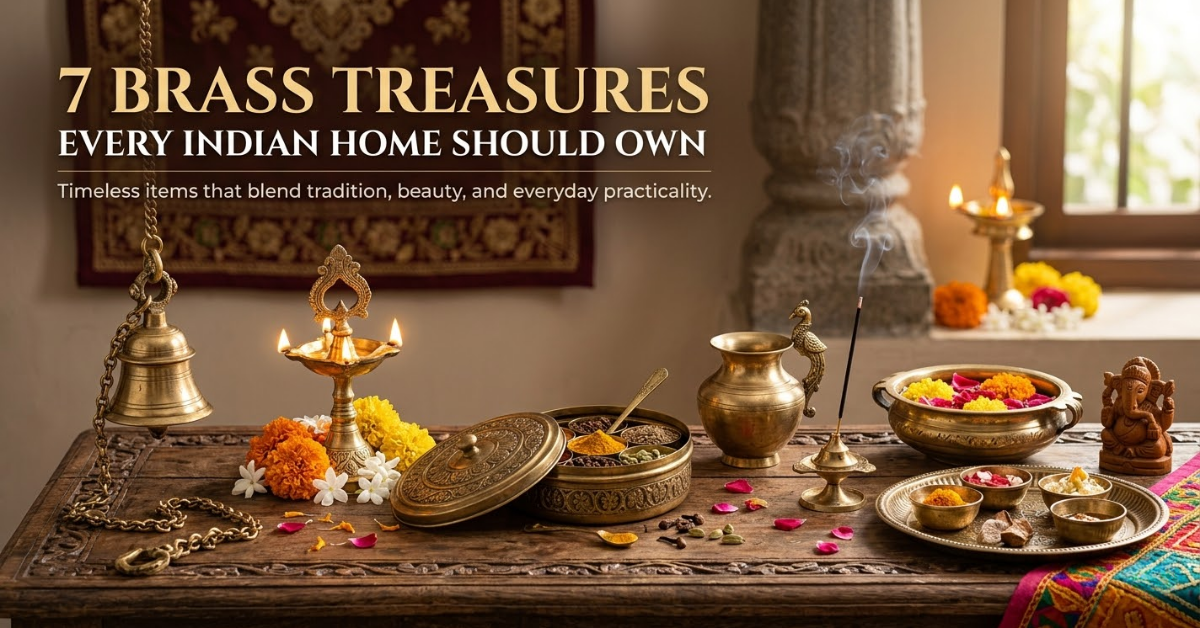
Take a moment and think about your childhood home.
Was there a small brass lamp glowing during evening prayers? Maybe a brass bell ringing softly in the pooja room? Or perhaps a brass water vessel sitting quietly near the temple shelf?
For many Indian families, brass items have always been part of everyday life. They weren’t just decorative objects. They served practical purposes while also carrying cultural and spiritual meaning.
But somewhere along the way, modern kitchens and homes shifted heavily toward steel, plastic, and glass.
Convenient? Absolutely.
Yet many households today are slowly rediscovering the charm and value of traditional brass items.
If you’re curious about bringing a touch of tradition back into your home, here are seven timeless brass items that have been part of Indian households for generations.
Check out our brass items. Clicker here to shop now!
Let’s start with the most recognizable one.
The brass diya is probably the heart of many pooja rituals.
Lighting a diya symbolizes:
positivity
knowledge
spiritual awakening
Whether during daily prayers or festivals like Diwali, the gentle glow of a brass diya instantly creates a peaceful atmosphere.
And honestly, there’s something calming about lighting a lamp at the end of a long day, isn’t there?
Many families keep at least one brass diya permanently in their pooja room.
Have you ever wondered why a bell is rung during prayer?
According to tradition, the sound of the bell is believed to clear the mind and create a focused atmosphere for worship.
A brass bell produces a clear, resonant sound that feels both powerful and soothing.
When you ring it, the vibration is said to invite positive energy and attention toward the divine.
Even today, most temples use brass bells rather than other metals.
A pooja thali holds everything needed for prayer — diya, incense sticks, flowers, and kumkum.
While many materials are used today, brass pooja thalis remain a favorite for traditional households.
Why?
Because brass is durable and develops a beautiful character over time.
Plus, when arranged properly, a brass thali filled with ritual items looks incredibly elegant during festivals and ceremonies.
The kalash is one of the most sacred objects used in Hindu rituals.
It is typically filled with water and topped with mango leaves and a coconut during ceremonies.
You’ll see brass kalash used during:
housewarming rituals
weddings
Navratri celebrations
temple ceremonies
Symbolically, the kalash represents abundance, life, and divine energy.
That’s a lot of meaning packed into one simple vessel.
In traditional households, brass lotas were commonly used for storing drinking water.
Many people still believe that water stored in brass vessels may support digestion and overall wellness.
Beyond health beliefs, brass lotas also play an important role in religious rituals and offerings.
Even today, you’ll often see a brass lota placed beside the pooja altar.
Incense sticks are a regular part of many daily prayers.
And while incense holders come in various materials today, brass versions are especially popular because they’re:
heat resistant
durable
visually appealing
A brass incense holder not only serves a practical purpose but also adds a traditional aesthetic to the pooja space.
Small detail, big impact.
Now here’s a brass item that blends tradition with home décor beautifully.
The brass urli is a wide decorative bowl often filled with water, flowers, or floating candles.
You’ll commonly see it placed:
near the entrance of homes
in living rooms
during festive decorations
Adding fresh flowers to a brass urli creates a simple yet elegant welcoming display.
It’s one of those pieces that instantly makes a space feel warm and inviting.
You might be wondering.
In a world filled with modern materials, why keep brass items at all?
The answer is surprisingly simple.
Brass objects bring together function, tradition, and beauty.
They remind us of rituals that slow down daily life, even if just for a few minutes.
Lighting a lamp.
Ringing a bell.
Arranging flowers in a urli.
These small acts help create moments of calm in busy lives.
And sometimes, that’s exactly what a home needs.
1. Why are brass items commonly used in pooja rooms?
Brass is traditionally considered a pure and auspicious metal, making it ideal for spiritual rituals and sacred objects.
2. Do brass items require regular maintenance?
Yes, brass can tarnish over time. However, it can be easily cleaned using lemon, salt, tamarind paste, or brass cleaning solutions.
3. Are brass items safe for daily use?
Yes, brass items are safe and durable when properly maintained. Many traditional households have used them for everyday rituals and kitchen purposes.
4. What makes brass different from steel?
Brass is an alloy of copper and zinc and has a distinct warm golden color, while steel is silver-toned and generally requires less maintenance.
5. Can brass items be used for home decoration?
Absolutely. Items like brass urlis, lamps, and bowls are often used as decorative pieces in modern homes while still reflecting traditional aesthetics.
Since 1976. Pure Brass Pooja Articles & Kitchenware. Crafted with purity. Built to last. Trusted by generations of Indian homes.
Shri Dhanlaxmi Metal Industries
Baswan Galli, Cts No 4142/a/2, Hosur, Near Patson Agency, Belagavi, Karnataka – 590 003
Mob: +91 8296221234
Mob: +91 831 2488376
Email: sales@dmimart.in

No products in the basket.
No products in the basket.