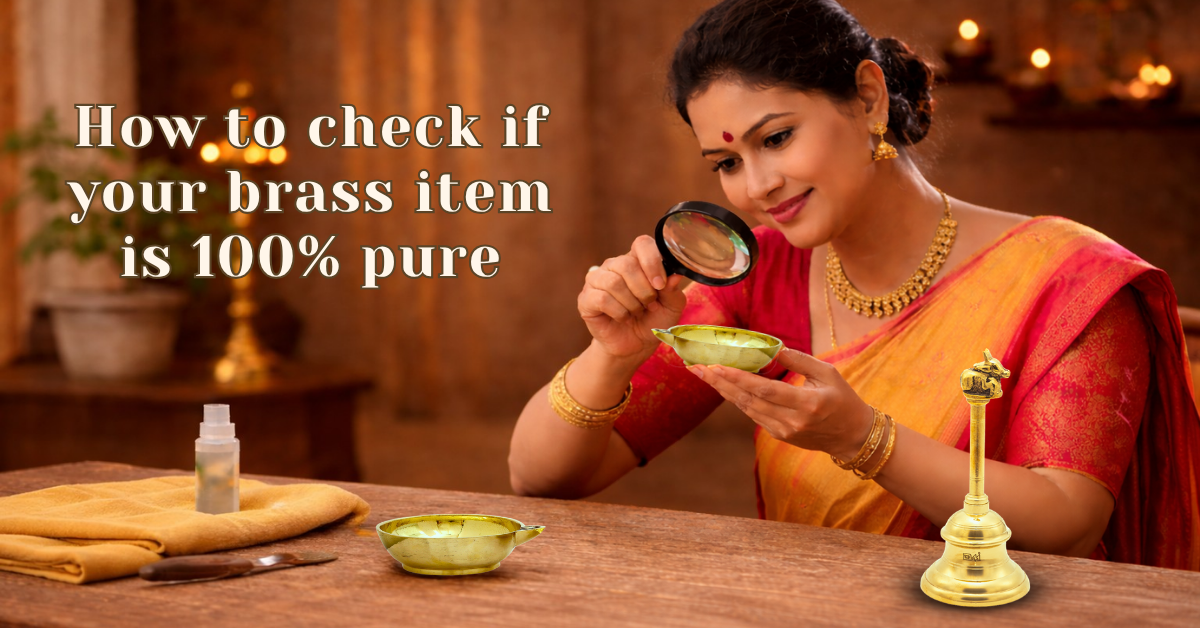
You’ve probably seen it happen.
You buy a beautiful brass diya, bell, or pooja thali. It shines perfectly in the shop, the color looks rich, and the seller assures you it’s pure brass.
But after a few weeks, doubts start creeping in.
The shine fades.
The color looks slightly different.
And suddenly you’re wondering…
“Is this actually real brass?”
If you’ve ever asked that question, you’re not alone. With so many brass-plated and mixed-metal items in the market today, it’s easy to get confused.
The good news?
Here’s one of the simplest checks you can try.
Take a regular household magnet and bring it close to the brass item.
Now watch what happens.
Pure brass is not magnetic. That means a magnet should not stick strongly to it.
If the magnet doesn’t stick, the item is likely brass or another non-magnetic metal.
If the magnet sticks firmly, the item may contain iron or steel underneath a brass coating.
This test works because brass is an alloy made primarily of copper and zinc, both of which are non-magnetic.
Simple, right?
But keep in mind: this test only tells you if iron is present. It doesn’t confirm purity completely.
Real brass has a distinct warm golden color.
Not too yellow.
Not too pale.
It usually sits somewhere between gold and deep yellow, with a slightly earthy tone.
Brass-plated items often look:
overly shiny
too bright
slightly artificial in color
Another thing to watch for is color wear.
If you notice patches where a different metal color appears underneath, it may be a plated item rather than solid brass.
Here’s a trick many experienced buyers use.
Lift the item.
Solid brass items usually feel surprisingly heavy for their size.
This is because brass is a dense metal.
Brass-plated items, on the other hand, often feel light and hollow, especially if they are made with thin base metals.
So next time you compare two similar items in a shop, try holding them.
You might immediately notice the difference.
This one might sound a little unusual, but it’s commonly used by traditional metal craftsmen.
Gently tap the brass item with your finger or a small metal spoon.
Listen carefully.
Solid brass often produces a clear ringing sound.
Cheaper alloys or plated items tend to produce a dull or flat sound.
This happens because different metals vibrate differently when struck.
Of course, this method isn’t foolproof, but it’s another small clue you can combine with other tests.
Here’s something many people misunderstand.
When brass slowly turns darker over time, some buyers think it’s a bad sign.
Actually, it’s the opposite.
Real brass naturally tarnishes.
Exposure to air and moisture causes oxidation, which creates darker patches or a slightly brown tone.
But here’s the key point.
This tarnish can easily be cleaned with simple methods like:
lemon and salt
tamarind paste
mild brass cleaning powder
Once cleaned, the shine returns beautifully.
Brass-plated items, however, may lose their coating permanently once the top layer wears away.
Authentic brass items often show signs of traditional craftsmanship.
Look closely at the surface.
You might notice:
slight hand-finished marks
thicker edges
detailed engravings
Mass-produced plated items often look too uniform or overly polished.
Sometimes imperfections are actually a sign that the item was crafted with real metal rather than just coated.
Buying brass items — especially pooja items — is often about more than just decoration.
These objects are part of daily rituals, family traditions, and spiritual practices.
That’s why many people prefer authentic brass that can last for decades.
The next time you’re unsure about a brass item, try a few simple checks:
Use a magnet
Observe the color
Check the weight
Listen to the sound
Notice natural tarnishing
You don’t need to be a metal expert.
A little awareness goes a long way.
And once you start recognizing real brass, you’ll probably never look at those shiny shop displays the same way again.
1. Can brass items rust?
No, brass does not rust because it does not contain iron. However, it can tarnish or darken over time, which is completely natural.
2. Why do brass items turn black?
Brass reacts with air and moisture, causing oxidation. This creates dark patches on the surface, which can be cleaned easily.
3. Is brass better than brass-plated items?
Yes. Solid brass items are more durable, longer-lasting, and easier to restore compared to brass-plated products.
4. Can vinegar be used to clean brass?
Yes, vinegar combined with salt or flour can help remove tarnish from brass items and restore their shine.
5. Are antique brass items more valuable?
Often, yes. Older brass items are sometimes heavier and made with traditional craftsmanship, making them both durable and culturally valuable.
Check out our pooja products here – https://dmimart.in/product-category/pooja-items/
For more such updates. Click here!
Since 1976. Pure Brass Pooja Articles & Kitchenware. Crafted with purity. Built to last. Trusted by generations of Indian homes.
Shri Dhanlaxmi Metal Industries
Baswan Galli, Cts No 4142/a/2, Hosur, Near Patson Agency, Belagavi, Karnataka – 590 003
Mob: +91 8296221234
Mob: +91 831 2488376
Email: sales@dmimart.in

No products in the basket.
No products in the basket.