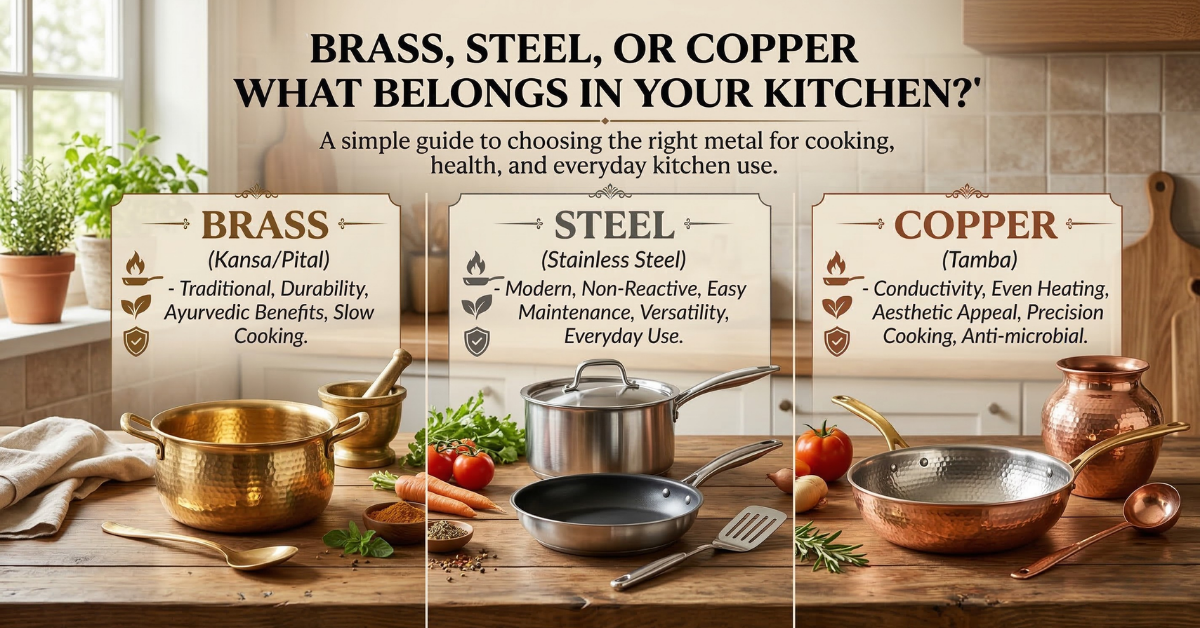
Walk into any Indian kitchen and you’ll probably notice something interesting.
Some homes use steel utensils everywhere. Others proudly keep copper water bottles on the dining table. And in many traditional kitchens, you’ll still find brass vessels quietly doing their job.
So here’s the big question.
Which metal is actually best for your kitchen — brass, steel, or copper?
If you’ve ever stood in a store wondering which utensils to buy, you’re not alone. Many people choose based on price or appearance. But the truth is, each metal has different benefits, uses, and traditions behind it.
Let’s break it down in a simple way so you can decide what works best for your home.
Before we compare them, think about this for a moment.
Your cooking utensils are in daily contact with food, heat, and water. The metal you use can influence:
Cooking performance
Durability
Health benefits
Maintenance effort
That’s why traditional Indian kitchens often used different metals for different purposes instead of relying on just one type.
Let’s look at each metal closely.
If there’s one metal that dominates modern kitchens, it’s stainless steel.
And honestly, it makes sense.
Steel utensils are everywhere because they’re:
Durable
Affordable
Rust-resistant
Easy to maintain
You can cook almost anything in them without worrying about reactions with food.
That’s a huge advantage.
Steel works well for:
Cooking daily meals
Pressure cookers
Storage containers
Plates and bowls
It’s practical, reliable, and doesn’t require special care.
But here’s the catch.
Steel is not the best conductor of heat, which means food sometimes cooks unevenly unless the utensil has an aluminum or copper base.
Still, for everyday convenience, steel remains the most widely used kitchen metal today.
Copper utensils have made a big comeback in recent years.
You’ve probably seen those shiny copper water bottles and glasses everywhere.
But copper’s story actually goes back thousands of years in Indian households.
According to traditional practices, storing water in copper vessels may help:
Improve digestion
Support immunity
Maintain microbial balance
Many people believe drinking copper-infused water (Tamra Jal) in the morning supports overall wellness.
Copper is commonly used for:
Water bottles
Drinking glasses
Decorative serving vessels
However, pure copper is not ideal for cooking acidic foods, because it can react with ingredients like tomatoes or lemon.
That’s why many copper cookware items are lined with tin or stainless steel inside.
Now let’s talk about a metal that was once extremely common in Indian kitchens.
Brass.
If you visit your grandparents’ home, you might still see brass vessels used for cooking or serving.
So why was brass so popular?
Brass (an alloy of copper and zinc) offers several advantages:
Excellent heat conductivity
Strong and long-lasting
Traditionally believed to support digestion
Brass utensils were often used for cooking foods like rice, curries, and lentils.
The metal distributes heat evenly, which helps food cook properly.
Brass works well for:
Cooking traditional dishes
Serving food
Pooja utensils
Storage containers
However, brass requires regular polishing and maintenance, which is one reason modern households moved toward steel.
Still, many people today are rediscovering brass because of its traditional and aesthetic value.
The truth is, there isn’t a single “best” option.
Each metal has its own strengths.
Here’s a simple comparison:
Metal | Best For | Pros | Cons |
|---|---|---|---|
Steel | Everyday cooking | Durable, low maintenance | Average heat conduction |
Copper | Drinking water | Traditional health benefits | Not ideal for direct cooking |
Brass | Cooking & rituals | Excellent heat distribution | Needs cleaning and care |
And honestly, that approach still makes sense today.
Instead of choosing just one metal, many households now combine them.
For example:
Steel for daily cooking
Copper for drinking water
Brass for traditional cooking and pooja
This combination gives you the best of convenience, tradition, and health awareness.
Plus, let’s admit it — a kitchen with a few brass and copper pieces looks beautiful and timeless.
1. Is brass safe for cooking?
Yes, brass utensils are safe for cooking when properly maintained. However, they are often lined with tin (called “kalai”) to prevent reactions with acidic foods.
2. Why do people drink water from copper vessels?
Copper vessels are traditionally believed to improve digestion, support immunity, and help balance the body when water is stored in them for several hours.
3. Which metal is easiest to maintain?
Stainless steel is the easiest to maintain because it resists rust, doesn’t react with food, and can be cleaned easily with regular dishwashing.
4. Can brass and copper utensils be used daily?
Yes, they can be used daily, but they require more care and regular cleaning to prevent tarnish and maintain their shine.
5. Why did modern kitchens shift to steel?
Steel became popular because it is affordable, durable, and low maintenance, making it ideal for busy modern lifestyles.
Since 1976. Pure Brass Pooja Articles & Kitchenware. Crafted with purity. Built to last. Trusted by generations of Indian homes.
Shri Dhanlaxmi Metal Industries
Baswan Galli, Cts No 4142/a/2, Hosur, Near Patson Agency, Belagavi, Karnataka – 590 003
Mob: +91 8296221234
Mob: +91 831 2488376
Email: sales@dmimart.in

No products in the basket.
No products in the basket.