Have you ever noticed something interesting when you visit a temple?
No matter where you go — a small village temple, a famous pilgrimage site, or even the pooja room in someone’s home — the lamps are almost always made of brass.
Not steel.
Not aluminum.
And rarely copper.
So why is that?
Is it simply tradition… or is there a deeper reason behind it?
If you’ve ever wondered about the meaning behind this simple yet powerful ritual object, you’re not alone. Let’s explore why brass lamps have remained central to temple worship for centuries and what they symbolize in spiritual practice.
In Hindu traditions, lighting a lamp is one of the most sacred acts of worship.
The flame represents several powerful ideas:
Knowledge over ignorance
Good over evil
Divine presence
Hope and positivity
When a priest lights the temple lamp before prayers begin, it symbolizes inviting divine energy into the space.
Think about it.
Before the rituals start, before the bells ring, and before devotees begin praying, the lamp is lit. That glowing flame becomes the spiritual center of the temple moment.
It’s not just light. It’s a symbol of awakening.
Now here’s where things get interesting.
Temples could technically use lamps made from many metals. But for centuries, brass has been the preferred choice.
There are several reasons for this.
In many Indian traditions, metals are believed to carry different energetic qualities.
Brass is often considered a “sattvic” metal, meaning it supports purity, clarity, and positive vibrations.
That’s why brass is commonly used for sacred objects like:
Temple bells
Pooja plates
Kalash (sacred pots)
Idols and lamps
When used in rituals, brass is believed to help retain and radiate spiritual energy.
Whether you believe in energy or not, it’s fascinating how consistently this metal appears in sacred spaces across India.
Temples are places where rituals happen every single day.
Lamps are lit morning and evening, sometimes multiple times a day. That means the metal needs to withstand:
Heat from the flame
Oil exposure
Constant handling
Brass is incredibly strong and durable, which makes it perfect for this purpose.
In fact, some temple lamps have been used for hundreds of years.
Imagine that for a moment.
A lamp lit today might be the same one that generations before us prayed in front of.
That continuity adds a powerful emotional layer to the ritual.
Another practical reason is heat conductivity.
Brass distributes heat evenly and handles high temperatures without easily warping or cracking. This makes it ideal for lamps that burn oil or ghee for long periods.
Steel can also handle heat, but brass tends to retain warmth and maintain stability during long rituals.
This is especially important during festivals when lamps may remain lit for hours.
Let’s talk about something more subtle.
The visual impact.
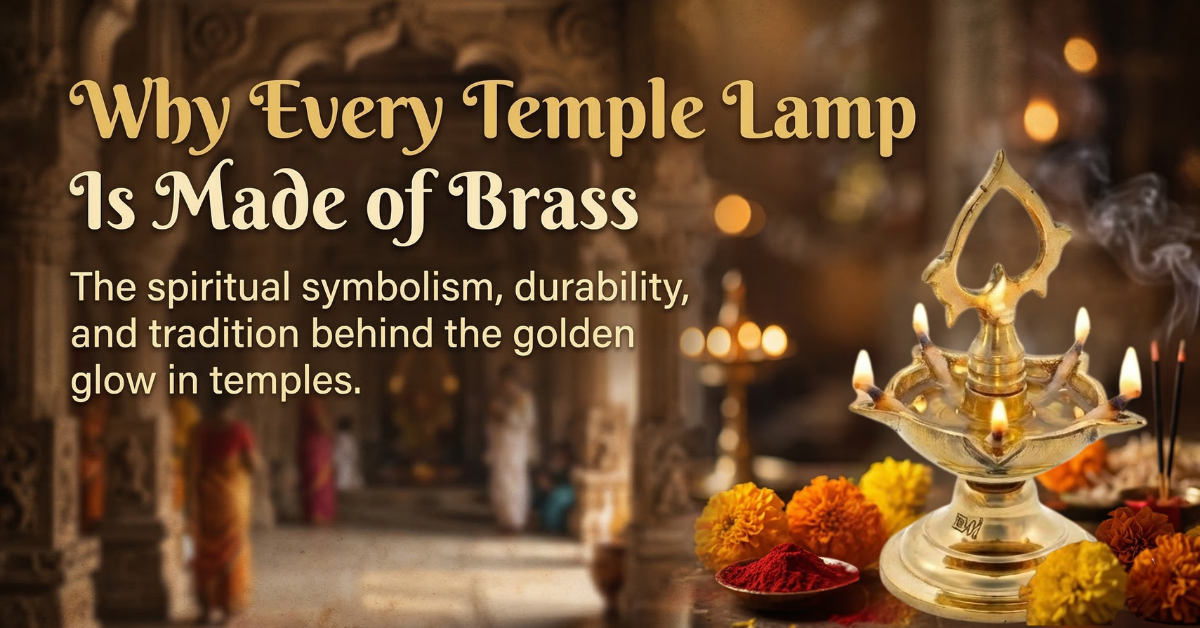
Brass has a warm golden color that reflects flame beautifully. When a diya burns inside a polished brass lamp, the metal reflects the light, creating a soft radiant glow.
That glow fills the temple with a peaceful atmosphere.
If the same lamp were made from steel, the effect wouldn’t be the same.
Sometimes traditions survive simply because they feel right.
And the warm glow of brass lamps certainly does.
There’s also something deeply cultural at play here.
For thousands of years, temple artisans and craftsmen have created intricately designed brass lamps.
From tall South Indian lamps (Kuthu Vilakku) to small diyas, each design carries regional artistic traditions.
Over time, these objects became symbols of devotion and cultural heritage.
So when a temple uses a brass lamp, it’s not just about functionality. It’s about continuing a tradition that connects generations of worshippers.
Interestingly, many households follow the same practice.
In countless Indian homes, you’ll find a brass diya or lamp in the pooja room.
Lighting it every morning or evening mirrors the ritual performed in temples.
It’s a small act, but one that brings a sense of peace and routine to daily life.
Some families even pass down brass lamps as heirlooms, making them part of family history.
When you look at a temple lamp next time, you might see it differently.
It’s not just a container for oil and flame.
It represents:
spiritual awakening
cultural tradition
craftsmanship
continuity across generations
And perhaps that’s why brass lamps have never gone out of style.
After all, traditions that carry meaning tend to survive the longest.
1. Why are temple lamps usually made of brass?
Brass is considered spiritually pure and durable. It handles heat well, reflects light beautifully, and has been traditionally used in sacred rituals for centuries.
2. Can temple lamps be made from other metals?
Yes, lamps can technically be made from steel, copper, or silver. However, brass remains the most widely used because of its spiritual significance and durability.
3. What oil is used in temple lamps?
Temple lamps commonly use:
Sesame oil
Ghee (clarified butter)
Coconut oil
Different temples follow different traditions.
4. Why do temples keep lamps burning continuously?
Some temples maintain Akhand Jyoti, meaning an eternal flame. It symbolizes constant divine presence and uninterrupted spiritual energy.
5. Can we keep a brass lamp in our home pooja room?
Yes, many households keep brass lamps in their pooja rooms and light them daily during prayer. It is considered a sacred and positive ritual.
Since 1976. Pure Brass Pooja Articles & Kitchenware. Crafted with purity. Built to last. Trusted by generations of Indian homes.
Shri Dhanlaxmi Metal Industries
Baswan Galli, Cts No 4142/a/2, Hosur, Near Patson Agency, Belagavi, Karnataka – 590 003
Mob: +91 8296221234
Mob: +91 831 2488376
Email: sales@dmimart.in

No products in the basket.
No products in the basket.